
7 Best Multicolor Mood Lighting Products for Global Buyers
Multicolor Mood Lighting is moving beyond decorative novelty. It now shapes bedrooms, gaming corners, hospitality spaces, retail displays, and everyday work areas. Global buyers are looking for products that combine expressive color with dependable performance. Brightness control, color accuracy, app stability, heat management, and plug compatibility deserve equal attention. A beautiful lamp can still disappoint when its colors look uneven or its software disconnects nightly.
Lighting researcher Jennifer Veitch has stated, “Light affects people’s health, productivity, and well-being.” Her observation gives this product category a practical foundation. Multicolor Mood Lighting should support comfort, not merely produce dramatic visual effects. Soft amber can make a reading chair feel warmer. Cool blue may sharpen a late-night workspace, although personal response differs. Red, purple, and green can create atmosphere, but excessive saturation may feel tiring after several hours.
This guide examines seven products selected for international buyers. Each option is considered through real-use details, including installation effort, control methods, brightness range, materials, energy use, and after-sales reliability. Some products excel in compact rooms. Others suit larger hospitality or entertainment settings. None is perfect. App permissions can feel intrusive, and built-in presets may seem repetitive. These limitations matter when purchasing across regions. Readers should still verify voltage, socket standards, wireless compatibility, warranty coverage, and local availability before ordering. The goal is not to crown one universal winner. It is to identify the right lighting behavior for different spaces, budgets, and habits.
What Multicolor Mood Lighting Is and How It Works
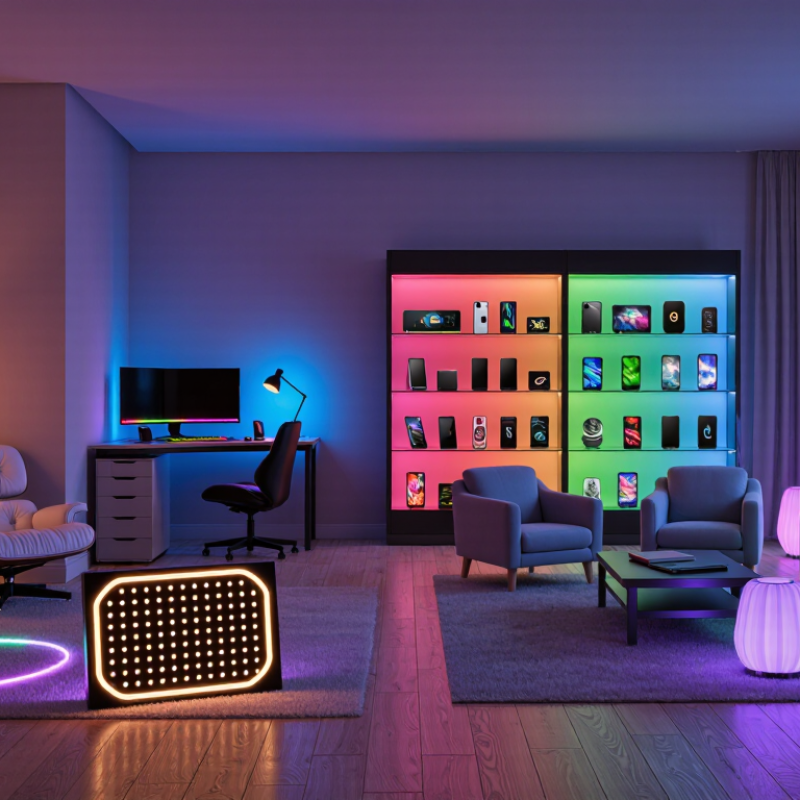
Multicolor mood lighting combines red, green, and blue light sources to create adjustable colors and gentle ambient effects. A controller changes each channel’s intensity, producing warm amber, cool blue, violet, or blended tones. Some fixtures add white LEDs for better reading and skin-tone accuracy. In practical use, a small wall wash can soften a harsh room, while a desk lamp can create a focused evening atmosphere.
The technology usually relies on LEDs, sensors, and wireless controls. LEDs convert electrical current into light through a semiconductor, with less heat than older lamps. The U.S. Department of Energy reports that LED products use at least 75% less energy and last up to 25 times longer than incandescent lighting. That matters for global buyers managing replacement costs and energy targets. It is not the whole story.
Color quality can still vary. Cheap products may show uneven blends, visible flicker, or weak whites. The International Energy Agency continues to identify efficient lighting as an important energy-saving opportunity, but efficiency does not guarantee comfortable illumination. Buyers should check color-rendering information, dimming performance, control compatibility, and electrical certification for the destination market. CIE lighting guidance also warns that blue-rich light can influence alertness and sleep timing. Use softer, warmer settings near bedtime. Research is still developing, and personal responses differ. A vivid setting may look impressive online, yet feel tiring after several hours.
7 Best Multicolor Mood Lighting Products for Global Buyers - What Multicolor Mood Lighting Is and How It Works
Multicolor mood lighting uses LEDs that mix red, green, and blue light to create a wide range of colors. Products with a dedicated white LED channel, commonly identified as RGBW or RGB+CCT, can also produce more natural white light and adjustable warm-to-cool tones. Color changes are controlled through a wall switch, remote, mobile app, voice assistant, or an external controller.
| No. | Product Type | Typical Light Source | Typical Specifications | Control Methods | Recommended Use | Key Buying Consideration |
|---|---|---|---|---|---|---|
| 1 |
Smart Multicolor Bulb A screw-in or bayonet lamp designed for standard indoor fixtures. |
RGB or RGBW LED |
5–12 W input power Approximately 400–1,100 lumens E26/E27, B22, or other regional bases Usually 220–240 V or 100–240 V |
Mobile app, Wi-Fi, Bluetooth, remote control, voice assistant, or physical switch | Bedrooms, living rooms, reading areas, rental properties, and small hospitality spaces | Check socket compatibility, voltage range, white-light quality, app compatibility, and whether a hub is required. |
| 2 |
Flexible RGB or RGBW LED Strip A cuttable and bendable strip for indirect or accent lighting. |
Surface-mounted LED chips on a flexible circuit board |
Commonly 12 V or 24 V DC Typical density: 30–120 LEDs per metre Common lengths: 2–5 m per reel IP20 for dry areas; IP65 or higher for protected damp locations |
Inline controller, RF remote, app, DMX controller, or smart-home platform | Ceiling coves, cabinets, shelves, stairs, TV walls, bars, and retail displays | Match the power supply to the strip voltage and wattage; use aluminium channels for heat management and diffused light. |
| 3 |
Addressable Pixel LED Strip A digitally controlled strip that can display different colors in separate sections. |
Individually addressable RGB or RGBW LED pixels |
Commonly 5 V, 12 V, or 24 V DC Pixel density often ranges from 30–144 pixels per metre Supports animated patterns and segmented color effects |
Dedicated pixel controller, app, Wi-Fi controller, Art-Net, or DMX-compatible system | Events, entertainment venues, gaming rooms, architectural features, and interactive installations | Confirm protocol compatibility, data direction, injection points, controller capacity, and total power demand. |
| 4 |
Color-Changing Light Panel A flat modular panel that combines decorative illumination with geometric layouts. |
Edge-lit or back-lit RGB/RGBW LED array |
Typically 5–15 W per panel Common panel sizes: about 20–30 cm per side Modular systems may support multiple connected panels Indoor use is standard |
Touch control, app, Bluetooth, Wi-Fi, or music-reactive software | Home offices, gaming areas, bedrooms, studios, content-creation backgrounds, and lounges | Review mounting method, panel expansion limits, software availability, and whether the power adapter is included. |
| 5 |
RGB Light Bar or Floor Light A vertical or horizontal fixture that provides decorative wall washing. |
Integrated RGB or RGBW LED modules |
Approximately 10–30 W per light Typical height: 0.5–1.5 m for floor-standing models Aluminum or plastic housing with a diffuser Indoor-rated designs are most common |
Remote control, touch buttons, app, Bluetooth, or music synchronization | Living rooms, media rooms, gaming setups, restaurants, exhibitions, and photo backgrounds | Compare beam spread, base stability, diffuser quality, brightness at a distance, and cable length. |
| 6 |
Portable Rechargeable Mood Lamp A cordless lamp intended for flexible placement and temporary use. |
Integrated RGB or RGBW LED |
Commonly 1–5 W LED power Rechargeable lithium-ion battery Typical operating time: about 6–24 hours, depending on brightness and battery size USB charging is common |
Touch control, onboard button, remote control, or mobile app | Dining tables, balconies, bedside tables, outdoor hospitality areas, and travel use | Check battery capacity, charging connector, IP rating, charging time, handle design, and replacement-battery policy. |
| 7 |
Color-Wash or Star-Projector Lamp A compact optical device that projects colored light, patterns, or points onto nearby surfaces. |
RGB LED with lens, diffuser, or rotating optical components |
Usually 3–15 W input power USB or low-voltage DC power is common Some models include rotation, timers, brightness adjustment, and sound-reactive modes Indoor use is typical |
Remote control, onboard buttons, Bluetooth, app, or microphone-based sound reaction | Bedrooms, children’s rooms, parties, lounges, themed interiors, and decorative displays | Assess projection coverage, fan noise, safety certification, timer functions, and whether moving parts are durable. |
Note: Specifications shown are typical market ranges for the listed product categories rather than the specifications of a particular manufacturer. Actual brightness, power consumption, color accuracy, ingress protection, control protocol, and operating time vary by model and region.
Related Posts
-
Discover the Best Garden Globe Lights for Your Outdoor Spaces?
-
Top 10 Tips for Choosing the Best Led Light Strips?
-
Best Yard Globe Lights for Your Outdoor Space How to Choose?
-
Why Choose Colorful LED Lights for Your Home Decor?
-
Top Solar Globe Lights for Outdoor Decoration in China?
-
What are the Best Yard Globe Lights for 2026?